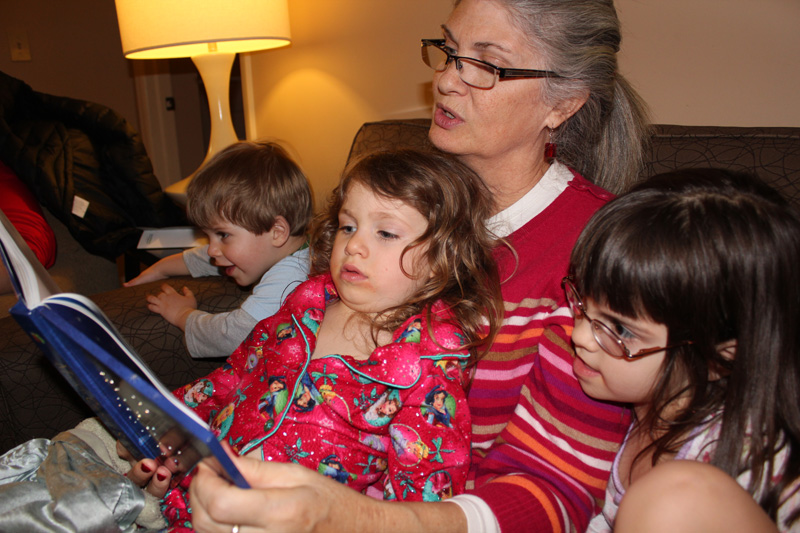
Our Beautiful Daughter
I was recently asked if we had any news on the results of Ellie evaluation at Cincinnati Children's! It reminded me that I've done a poor job of sharing here what we've been learning this fall in regards to our sweet girl.
Here's a brief recap: Because of a cancellation, Ellie's
initial evaluation was moved up from December to mid-September. The physician didn't believe that Ellie clearly presented as autistic (because her social and verbal skills were relatively strong), but that she may have some language processing issues and sensory needs resulting from a year and a half of crib confinement in the orphanage. She ordered an austism and language assessment over three different appointments (one in October, one in November, and one in December), with the team coming together and sharing their findings with us in February.
Ellie's testing is complete now and we are more than curious to get the results (which they warned us would be like trying to drink from a firehose). In the language testing, the only thing we know so far was that she didn't fail the vocabulary test until reaching the age-13 language level! Attribute that to smart parents (ahem) or more likely, a combination of natural intelligence and living in a community of college students. ;-) What we're most interested in is her receptive language score as she lagged significantly in this area as a Kindergardener.
During the autism assessment, Nathan (who observed the testing via video feed in a separate room) was initially frustrated by her lack of seriousness in participating in the initial stages of testing. Ellie has a tendency to use humor/silliness for attention, or, we suspect, when she knows the material so well she finds it boring. She eventually snapped out of that and finished relatively well. At one point she had to predict where an object was hidden after several moves under a cover (think the "shell game"). Nathan said that every single time she would guess wrong. Every. Single. Time. Given that Nathan does a lot of disappearing magic tricks for her, he suspected that she was guessing wrong to 'save face' for the tester or again, make a game out of something that was 'too easy' for her. All the while she demonstrated all of her repetitive motions and other quirky behaviors so that the psychologist was shaking her head over Ellie's behaviors which on one hand appear so autistic yet also completely contradict an ASD diagnosis.

Over the course of the fall between trips to Cincinnati we've been studying the research of Dr. Purvis and her team at Texas Christian University through videos and discussion at our monthly Adoption Support Group (what a blessing, I can't even describe). In November a few of the researchers at the TCU Child Development Institute came to Lexington to conduct a parenting seminar which we were able to attend. We found their information
so valuable for filling in some "blanks" I've always had in trying to understand the
physiological affects of institutionalization on the brains of children, particularly in the crucial first three years.
Ellie's first speech therapist had introduced us to the term "Institutional Autism" in 2007, giving us an older article by some researchers in the United Kingdom. They reported that between 15-20% of children in E. European orphanages were prone to develop something they called Institutional Autism (vs. organic autism, which at the time they believe couldn't be 'unlearned'). They felt it affected particularly sensitive children and was manifested by rocking, eating/chewing/swallowing issues, and emotional withdrawal -- all of which were manifested in our Ellie (and the % played out pretty accurately in her orphanage's population). The article gave us hope that these behaviors could be overcome with placement in a family and early intervention therapies, but no "why's" for the causes of this behavior other than that their little bodies were 'self-soothing'.
A few years later I came across a very brief news snippet in Adoptive Families magazine that mentioned that brain scans of institutionalized children revealed enlarged amygdalas (the part of the brain that stores emotional memories), similar to children with autism. Interesting stuff, but no more explanation.
I could understand why when we brought Ellie home she couldn't walk (no muscle tone from laying in bed all day), could not chew or tolerate solid food or objects in her mouth (no oral stimulation from chew toys, solid food, or eating off of a utensil), and why she had strabismus (nothing but a white ceiling to look at). What I didn't understand was why all the other sensory and learning issues. What was it about the early trauma that makes a child more prone to struggle with these things?
This is where the team from TCU provided so many "light bulb" moments for us. I was calling our parents and spewing back as much of the information we could remember and salvage from our pages of hastily scrawled notes. For the sake of others who might be interested, I will share my notes, but I believe the information is deserving of it's own, separate post (this one is long enough already).
Suffice it to say, the information explained so much of Ellie's behavior to us. It made us more empathetic to her fears and anxieties. It gave us tools for parenting her where traditional parenting techniques just don't work (but only escalate matters to where discipline is not only unproductive, but seemingly detrimental). It gave us strategies for empowering her to have successful days without meltdowns and assist in her learning potential. It also reconfirmed that home schooling was the best decision for her particular needs right now. We are blessed to have discovered these resources for our daughter at this stage in her life.
I embark on posts like this with a bit of trepidation because the last thing I want to do is scare people away from the idea of adoption -- I want so badly to see abandoned, lonely children find homes with permanent families! These children come from backgrounds of deep, deep loss that leaves an imprint they will always carry with them. Thankfully, we have a Father who knows, relates, redeems and heals. In another post I'll explain how some of that healing can take place. Thanks for reading and hearing my heart tonight!